
129 Forefield Lane, Crosby, Liverpool, L23 9SL
(Above Aaron David Hair Design)
Established in 2014, Louise Beautique is a premium unisex beauty salon backed by over 20 years of professional experience.
For more than 12 years, we were proud to call
The Crescent, Thornton our home, building a reputation for high standard treatments and a loyal client base within the local community.
We are delighted to have settled in to our new home within Aaron David Hair Design, where we have created the perfect space to continue offering the premium beauty experience our clients know and love. While our location has changed, our commitment to exceptional service, quality treatments and outstanding client care remains exactly the same.
Whether you’re looking for your regular beauty treatments, or searching for a new salon you can trust, we’d love to welcome you.


We are now located at...
129 Forefield Lane, Crosby, L23 9SL
Above Aaron David Hair Design
(Brownmoor Shops)
Advanced Cosmetic Procedure (ACP)
ACP is a specialist treatment that uses precision electrolysis to safely treat a wide range of common skin blemishes, including:
• Skin tags
• Milia
• Blood spots (Campbell de Morgan)
• Spider naevi
• Seborrheic keratosis
• Cherry angiomas
• Age Spots
• Verruca / Warts
• Benign skin lesions (Moles - subject to assessment)
Many of these blemishes are no longer treated on the NHS, meaning lots of people are left with concerns they’d love to improve but aren’t sure where to go. That’s exactly why I wanted to bring this treatment to you.
Below is a list of all the blemishes that can be treated with Advanced Electrolysis, if you think you have any of the below and want to book a consultation to discuss treatment options, please click the link attached.

Skin Tags
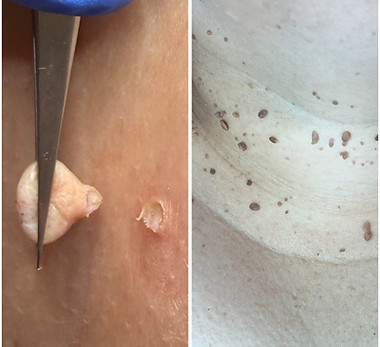
Skin Tags are often squidgy and soft, you can wriggle them around and can be pigmented or non-pigmented. They are often found in areas of friction such as the neck, under the armpit, groin, they increase with age. They often appear with a stalk and Skin Tags are removed quickly and easily by applying diathermy to the stalk or neck of the skin tag.
Benign skin lesions
(Moles - subject to assessment)

Moles are simply a collection of skin cells, blood vessels and are benign melanocytic naevi. Moles can contain no melanin, can be pigmented and even have hairs in them. Moles are highly vascular, and the average white-skinned adult has 20-30 moles.
Moles are treated extremely carefully and we must ensure they are stable. They are removed by applying diathermy to the surface of the mole, which seals off the blood supply. Sometimes 2 or 3 treatments are required for each mole depending on how large the mole is.
Please note that for Mole treatment a different pricing consultation will be discussed due to the nature of moles. A GP referral will be asked and written consent obtained, or a Map My Mole service will need to take place before treatment will take place.
Milia

White Heads also know as Milia, are tiny white spots that contain keratin and sebum, White Heads are white, pearly, rounded lumps which occur in the uppermost layer of the skin when sebum the oil produced naturally by the skin becomes trapped in a blind duct. The exact cause in unknown, however, some think it may be due to excessive vitamin C in the diet, or use of too rich a cream on the skin. White Heads are treated by applying diathermy, after treatment a tiny, pin-dot crust will form which will heal and fall away- usually within a few days.
Blood Spots (Campbell de Morgan)

Blood Spots are vascular blemishes and superficial. Blood spots appear as purple/red in colour and have a smooth surface, can be slighted raised, and domed shaped.
We would remove blood spots using electrolysis, a very tiny probe would be placed just under the skin’s surface and passing through a tiny amount of current to seal off the tiny capillary. This results in the capillary drying up and disappearing. The procedure is not painful at all, but may be a little uncomfortable, a little nip or sting.
Seborrheic Keratosis
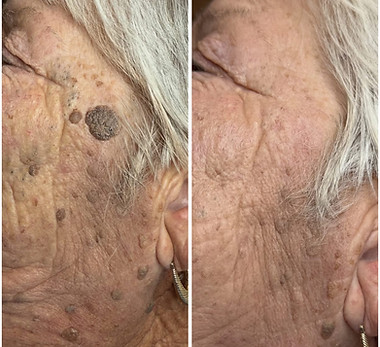
Seb K's vary greatly in appearance and can be any colour from skin colour to very dark brown. Seb K are oval or round and can be anything from a couple of millimetres to a few centimetres across. Although raised above the skin they have a flat surface which usually has grooves in it. They can be dry and crumbly. They are completely benign (non- cancerous) and occur with age- usually age 40 onwards. They can appear on any area of the face or body. They can also be hereditary. Seb K are removed by applying a heat energy known as diathermy to the base and are gently scraped off. Sometimes a second treatment is required, especially with larger ones.
Sebaceous Hyperplasia

These are simply enlarged oil sebaceous glands and are completely harmless. They occur mostly on the forehead, nose and cheeks- the areas where there are most oil glands. We remove Sebaceous Hyperplasia by gently tapping over the area with diathermy. they will dry up and disappear on
their own.
Cherry Angiomas

A cherry angioma is a common, harmless skin growth made of a cluster of tiny blood vessels. They appear as bright red, dome-shaped bumps (0.5 to 6 mm in diameter) and most frequently develop on the torso, arms, and shoulders. They are completely benign and not cancerous. The exact cause is unknown, but genetics and age play a major role. They are very common in adults over 30 and often increase in size and number with age. Usually, they are painless. However, because they contain blood vessels, they may bleed heavily if scratched or bumped.
DPN (Dermatosis Papulosa Nigra)

DPN are smooth, domed shaped little spots on the skin which are actually just very small Seb K. They most often, but not always, occur on darker skin. DPN is often hereditary. DPN are easily removed using electrolysis to gently scrap them off, a small scab can form, which should be allowed to slough off naturally.
Verruca / Warts

Warts & Verrucas are caused by infection of epidermal cells with the Human Papilloma Virus HPV. They can be contagious meaning they can be passed from one person to another by contact.
Common warts can be single or can appear in groups, they have a thickened, rough surface which sometimes has black dots in it- the black dots are just tiny blood vessels. Common Warts are most common on the hands.
Verrucas are just warts on the soles of the feet and are painful due to constant pressure of the weight on the body, they can occur in groups.
All types of warts are removed by inserting a little probe to the base of the wart, where the blood supply is and passing a heat energy known as diathermy to the area. This seals of the blood supply without which the wart cannot survive. Treatment is very effective, however very painful.
Age Spots

Age Spots are caused by an accumulation of a yellow pigment from ageing of the collagen producing cells. They are very common on the hands and face of middle aged and elderly patients and are usually despised by them as they are so recognisable a sign of increasing age. Chemical peels and skin whitening products are commonly used for treatment but electrolysis is also very effective. Using a very fine electrolysis needle a tiny section of the age spot is lifted from the underlying tissue and the colour underneath is observed. If the tiny area exposed is lighter in colour removal can go ahead with varying degrees of success. If the pigment underneath the tiny section lifted is the same colour as the age spot itself the pigment goes deep into the dermis and treatment will not be successful.

Telangiectasia (Thread Veins)
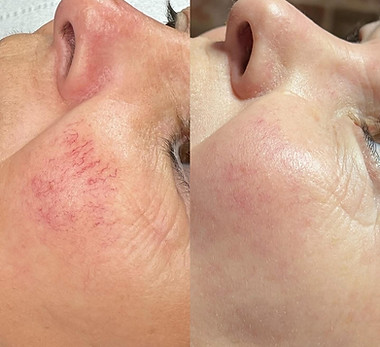
These are not ‘broken capillaries’ as so often named, but permanently dilated capillaries.
There are numerous causes for Telangiectasia including: ageing, hereditary and genetic causes, pregnancy, hormones, general skin fragility, smoking, extreme sports, temperature extremes and harsh weather exposure. They are very commonly seen in a maturing ‘English rose’ complexion.
A course of advanced electrolysis is often advised for telangiectasia so that treatments can be spaced out to prevent skin damage or hyper-pigmentation. Diathermy (like hair removal electrolysis) is used, which involves a very accurate positioning of the probe over the blood vessel and a gentle tap that applies current to the skin’s surface. This causes that tiny section of vessel to immediately disappear. Treatment sessions are usually for example 15 minutes per cheek.
Although not considered a cause of telangiectasia, rosacea (and the medication for it) may be a related factor, with the two conditions often presenting simultaneously.
Xanthelasma

Xanthelasma refers to the soft, yellowish cholesterol plaques that develop under the skin, usually on or around the eyelids or near the nose. While the growths themselves are benign and painless, they often serve as an indicator of underlying high cholesterol, lipid disorders, or an elevated risk for heart disease
Xanthelasma does not go away on its own. People typically seek removal for cosmetic reasons or because the plaques slowly grow over time
While removal is highly effective, xanthelasma has a high rate of recurrence, meaning new deposits can form in the same area
Syringoma

These little marks are caused by an overgrowth of the eccrine sweat glands. They most commonly appear around the eyes and can be mistaken for Milia. However, they are softer and are usually oval whereas Milia tend to be harder and round in shape. They are removed by gently scraping them away with diathermy.
Hyperpigmentation

Hyperpigmentation occurs when certain areas of the skin become darker than the surrounding skin due to an excess production of melanin, the pigment responsible for skin colour. This can result in darker patches that vary in intensity, ranging from light brown to almost black, depending on your natural skin tone. These patches, which can appear on the face, hands, or other areas exposed to the sun, are often uneven and can affect your confidence and overall complexion.
Hyperpigmentation generally falls into three main categories: melasma, post-inflammatory hyperpigmentation (PIH), and sunspots.